The Peruvian Fisherman’s Knot
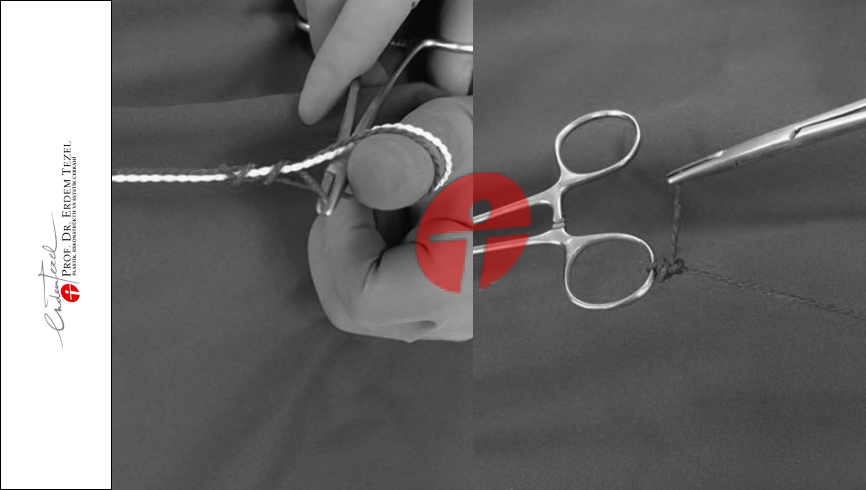
Tezel Techniques The Peruvian Fisherman’s Knot The Peruvian Fisherman’s Knot The Peruvian Fisherman’s Knot Background : In many plastic surgery operations that are undertaken through relatively small incisions resulting in deep-seated operating fields, sliding knots with a self-locking property are
Introduction and Overview
A flawless result in aesthetic surgery does not depend solely on the surgeon's discipline of incision or mastery of tissue planes. In modern surgical philosophy, a technically perfectly executed operation can end in failure because of knot security, regarded in the literature as the "weakest link". A knot slipping or coming undone under load means the loss of aesthetic gains.
The Peruvian Fisherman's Knot (PFK) is a revolutionary technique contributed to the surgical literature in order to minimize this critical risk. Scientifically codified in 2009 through the joint work of Oscar M. Ramirez, Erdem Tezel, and Burak Ersoy, this method had in fact been applied by Dr. Ramirez for over 20 years as a "field-tested" surgical secret. Today it is regarded as the gold standard of safety and precise adjustment in the deepest and narrowest working areas of plastic surgery.
1. What Is the Peruvian Fisherman's Knot? Its Difference from Traditional Knots
The Peruvian Fisherman's Knot technically falls into the category of "self-locking" and "sliding" knots. While surgical knots are basically divided into square knots and sliding knots, the PFK combines the advantages of both groups in a single mechanism.
Unlike traditional square knots, as the complexity of this knot increases, its security also increases in direct proportion. The PFK can be prepared outside the surgical field and easily slid inward (into deep tissue); but once it reaches its place, thanks to the optimization of friction in the suture strands, it shows extraordinary resistance to opening under load. The ease of sliding it provides on monofilament suture threads, followed by stability, is the most fundamental difference that sets it apart from traditional methods.
2. The Power in the Surgeon's Hands: Adjustable Tension and "Reversibility"
The most important feature that makes the PFK indispensable for a surgeon is the adjustable structure it offers. This mechanism gives the surgeon the flexibility to control tissue tension to the millimeter before fully locking the knot.
• A Surgical Safety Net (Reversibility): The greatest clinical advantage of this knot is that it is reversible until the final-stage "half-hitch" locks are applied. The surgeon suspends the tissue, checks the aesthetic result (for example, the level of a malar lift), and if not satisfied with the outcome can undo the knot and readjust it. This is a true "safety net" for the surgeon.
• Surgical Autonomy: With traditional knots, an assistant may need to fix the knot with a clamp. This intervention can both lead to synchronization errors between assistant and surgeon and cause the clamp to physically damage the suture material, jeopardizing knot security. The PFK allows the surgeon to tighten and lock the knot single-handedly (self-locking), providing complete operative independence.
3. Areas of Use in Aesthetic Surgery: Where and Why Is It Preferred?
The Peruvian Fisherman's Knot gives the surgeon an advantage of visibility and application in the body's most challenging anatomical regions:
• Endoscopic Facelift: Used in suspending the midface tissues — in particular the suborbicularis oculi fat pad (SOOF), the malar fat pad, and the buccal fat pad of Bichat — onto the temporal fascia proper. Even in narrow tunnels, the knot's locking mechanism guarantees the durability of the lifting effect.
• Canthopexy (Eyelid Aesthetics): In suspending the lower eyelid ligaments into the lateral orbital rim, it enables millimetric tension adjustment without the need for an assistant's help.
• Breast Aesthetics (Lateral Pillar Suspension): The PFK plays a critical role in suspending the breast tissue onto the pectoral fascia. The suspension created here, just like a "fishnet," supports the weight of the tissue and prevents the "bottoming out" phenomenon (the sagging of the breast).
• Nose Surgery (Rhinoplasty): Used as the mechanism of the septocolumellar sutures. Thanks to this knot, the medial crura are fixed to the caudal septum so rigidly that the septum acts almost like a "strut graft," providing the stability of the nasal tip without the need for an additional cartilage graft.
• Tummy Tuck (Abdominoplasty): In the repair of diastasis recti (separation of the abdominal muscles), it ensures that the deep fascial sutures do not loosen even under high tension.
4. Small Incisions, Deep Tissues, and Maximum Safety
Plastic surgery's vision of "maximum change with a small incision" often pushes the surgeon into narrow and deep working areas (deep-seated operating fields). Applying traditional knotting techniques in these areas restricts the surgeon's view.
The Peruvian Fisherman's Knot eliminates this problem thanks to its ability to be prepared outside the surgical field and slid inward (sliding). The knot's successful handling of the load it creates on the tissue even in narrow areas is the surgeon's greatest assurance in minimally invasive procedures.
5. Knot Security and Tissue Reaction in Light of Scientific Data
Scientific research shows that tissue reaction occurs most intensely at the knot region, where the density of foreign material is greatest.
• Low Tissue Reaction: Thanks to its complex structure, the PFK provides maximum security with a smaller number of "throws." Unlike traditional square knots, because it locks with a lower material volume (lower material density), it minimizes tissue trauma and foreign-body reaction.
• Clinical Evidence: This technique, shaped by the joint experience of Ramirez, Tezel, and Ersoy, has proven its success over thousands of cases and has entered the surgical literature as one of the knots most resistant to failure under load.
6. Frequently Asked Questions
Is there a risk of the sutures coming undone on their own? The knot's self-locking mechanism does not allow this. In addition, the 2 or 3 consecutive alternating half hitches applied at the end of the procedure turn the sliding structure into a permanent and unshakable lock.
Can this technique be used in every surgery? Yes. It is a versatile technique that can be used especially in all lifting operations requiring the suspension of deep tissues, in intraoral surgery (cleft palate), and in any kind of repair requiring precise tension adjustment.
What is the risk of the knot being felt or causing a tissue reaction? Because the knot volume is kept to a minimum, this risk is lower than with traditional knots. The reduction of material density increases biological compatibility with the tissue.
Conclusion: Perfection in the Detail
The Peruvian Fisherman's Knot is not merely an auxiliary technique in aesthetic surgery but a standard of safety that seals the success of the operation. This method, applied with the academic vision and surgical mastery of Prof. Dr. Erdem Tezel, gives the surgeon autonomy and the patient confidence. It should not be forgotten that the success of a surgical art lies hidden in the finest detail, and perfection in the detail is naturalness in the result.
This article describes surgical techniques introduced to the literature by Prof. Dr. Erdem Tezel.